Serving Grass Valley, Nevada City, Penn Valley, Truckee, Lake of the Pines, Alta Sierra, North San Juan, and all communities throughout Nevada County, California. Nevada County’s landscape is defined by its Gold Rush heritage, its mountainous terrain, and its mix of rural homesteads, forest parcels, and planned communities. These characteristics produce easement disputes that are both legally complex and factually distinctive. Whether...
Serving Rocklin, Roseville, Lincoln, Auburn, Loomis, Granite Bay, Newcastle, Penryn, and all communities throughout Placer County, California. When a disagreement over an easement threatens your ability to use, access, or enjoy your property, the consequences are not abstract. They are immediate, tangible, and frequently expensive. Whether a neighbor has blocked a shared driveway, a developer is asserting access across your parcel, or a...
Placer County transactions regularly involve higher-value homes, remodel-heavy listings, hillside drainage issues, roof/solar work, and ADU or expansion projects—exactly the fact patterns where unpermitted work, water intrusion, grading/drainage, and defect history become nondisclosure battlegrounds. If you suspect the seller (or agent) failed to disclose a material fact, the right approach is disciplined: identify the duty, lock down proof,...
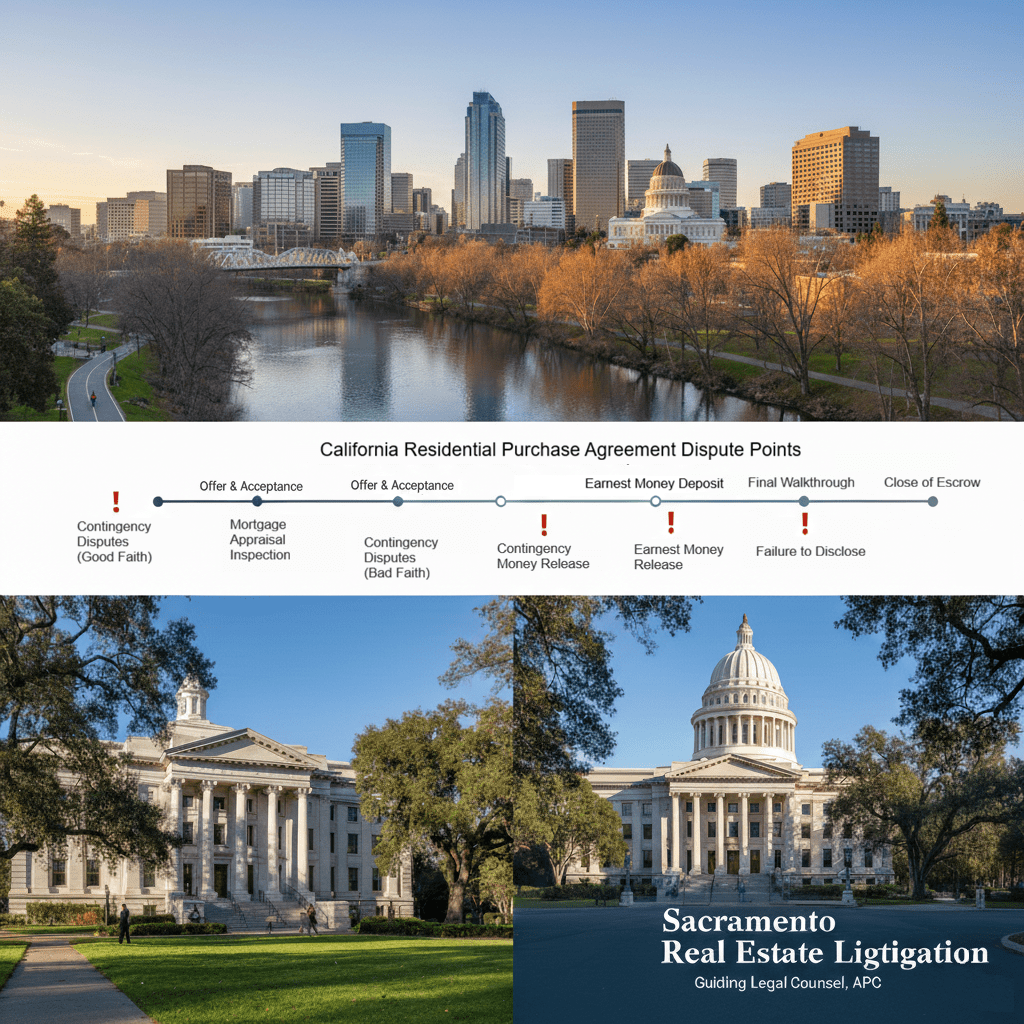
Buying or selling a home in the Sacramento Valley—from the historic blocks of Land Park to the suburban stretches of Lincoln and Roseville—is a massive financial undertaking. When one party fails to uphold their end of a California Residential Purchase Agreement (RPA), the dream of a smooth closing can quickly turn into a legal nightmare. If you are currently facing a breach of contract, a dispute over a deposit, or a failure to disclose,...
Investing in commercial real estate in California can yield significant returns, but it also entails a complex matrix of legal risks that differ substantially from residential property transactions. Commercial investments—whether involving office buildings, retail centers, industrial parks, or mixed-use developments—require careful navigation of lease structuring, zoning laws, financing instruments, environmental regulations, and potential...
Selling a home in California without a licensed real estate broker—commonly known as a “For Sale By Owner” (FSBO) transaction—may appear to offer greater control and cost savings. But FSBO sellers are not relieved of California’s complex legal obligations governing disclosures, contracts, and title transfer. In fact, by removing the broker from the transaction, sellers assume greater personal responsibility for legal compliance,...
The "For Sale By Owner" (FSBO) model offers homeowners an appealing alternative to traditional realtor-assisted transactions. By eliminating commission-based brokers, sellers may hope to retain more of the purchase price. However, this perceived simplicity conceals a complex framework of disclosure laws, contractual obligations, regulatory compliance, and litigation risk—all of which persist regardless of whether a licensed real estate agent...
Selling real estate without the assistance of a licensed real estate broker—commonly known as a For Sale By Owner (FSBO) transaction—does not exempt the seller from California’s strict disclosure obligations. While FSBO sellers may believe they are avoiding broker-related legalities, the law imposes non-delegable duties on sellers of residential property to disclose known material facts. Failure to do so exposes the seller to liability...
Understanding the Nature of Asset Purchase Agreements An Asset Purchase Agreement (APA) in the context of real estate is a multilayered contract that governs the acquisition of individual property interests, improvements, tangible and intangible assets associated with real property, as opposed to a mere transfer of shares or memberships in an entity that owns real estate. The APA elucidates which assets are transferred—land, buildings,...
Introduction In California's competitive real estate market, brokerage firms, agents, and affiliated professionals frequently explore ways to protect business goodwill, client relationships, and proprietary information. One mechanism often considered is the non-compete agreement—a contractual provision that restricts an individual’s ability to engage in similar business within a defined geographic area and timeframe after leaving employment...